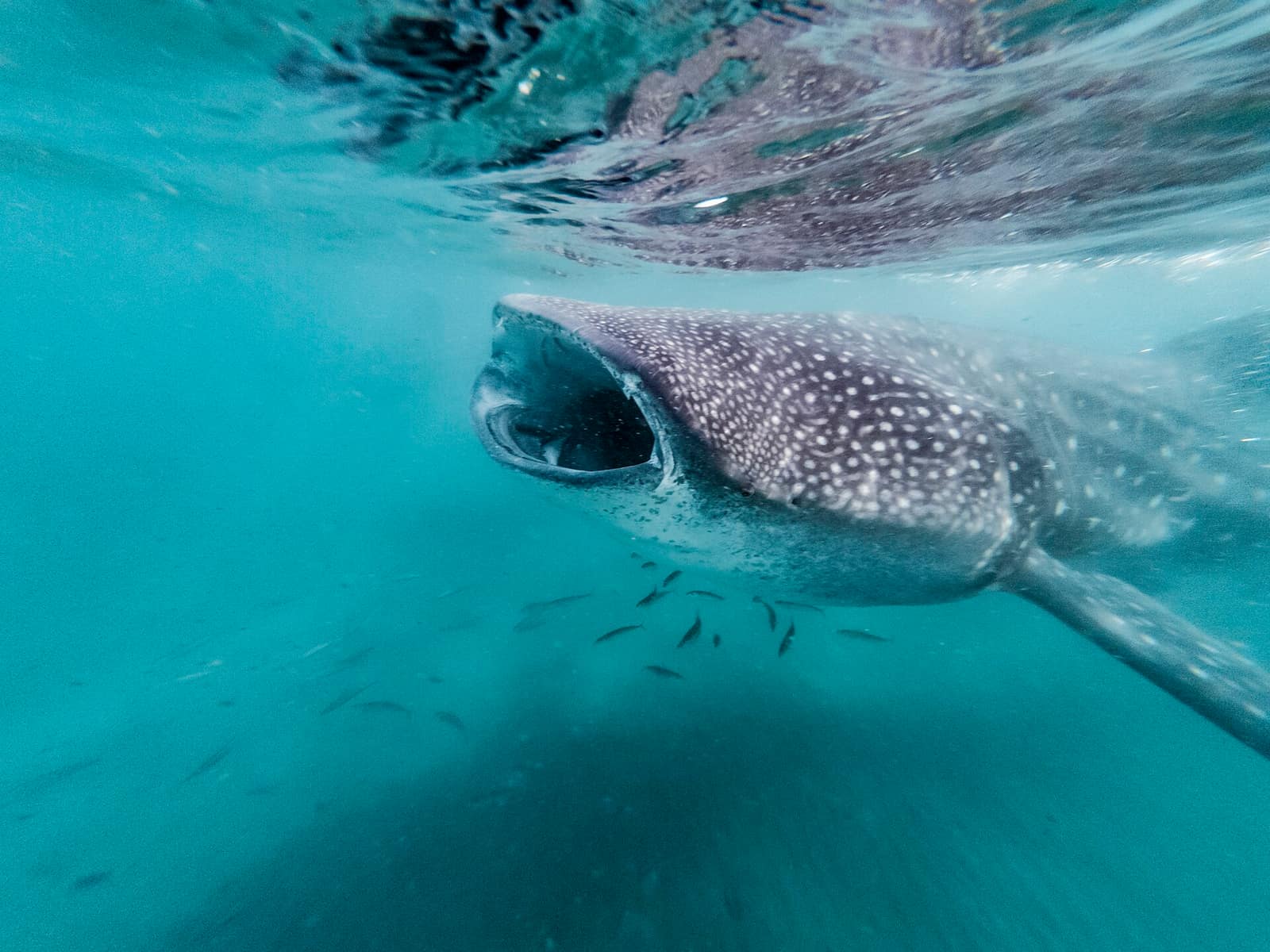
If you’re staying in Cabo and you’ve heard that swimming with whale sharks is one of the best things you can do in Baja, you’ve heard correctly. The whale sharks do not come to Cabo San Lucas, though. They aggregate in La Paz Bay, about 125 miles north up the Baja coast, and you get there the same way most people do: a two-to-two-and-a-half-hour drive on Federal Highway 1. That road trip is part of the experience, and the whale shark encounter at the end makes it one of the most worthwhile days you can spend on a Los Cabos trip.
This is a guide to swimming with whale sharks from Cabo, from the season and what to expect in the water to how to book a tour and what to bring for the day.
Why La Paz, Not Cabo San Lucas
Whale sharks are filter feeders. They cruise near the surface with their mouths open, straining enormous volumes of water to capture plankton, fish eggs, and small baitfish. They follow food concentrations, and the shallow warm-water bays around La Paz, particularly in the area off the Mogote Peninsula, are among the most reliable aggregation points in the eastern Pacific.
The sharks that gather here are typically juveniles between about 15 and 25 feet long. That sounds large, and it is, but whale sharks are the world’s biggest fish precisely because they’ve evolved to be inoffensive: no teeth designed for prey, no aggression toward snorkelers, and slow, predictable movement patterns that make in-water encounters manageable even for swimmers who are not experienced divers.
The whale shark season in La Paz runs roughly October through May, with the largest numbers of animals arriving between November and March. If your trip to Cabo falls in that window, the drive north is worth planning. If you’re visiting in summer, the sharks are mostly gone; check the whale shark and sea lion swims page for a current read on conditions and alternatives.
When to Go: Season and Conditions
The aggregation is most consistent and most dense November through February. Water visibility in La Paz Bay during those months typically runs 20 to 40 feet, which is enough to see the full length of the animal once you’re in the water beside it. Water temperatures run in the mid-to-high 70s°F in peak season, dropping to the low 70s in January and February.
October is the shoulder entry into the season. Numbers are building, but sightings are less guaranteed than in December or January. May is the tail end, when the aggregation is thinning out and individual encounters can be shorter. For the highest probability of a full, unhurried experience, November through February is the window to target.
October is also a time when the weather in Cabo is transitioning out of hurricane season and into the best stretch of the year. Planning a whale shark day trip in October or November puts you at the intersection of good Cabo weather and prime La Paz season.
What Happens When You Get in the Water
The boat ride from La Paz takes 20 to 45 minutes depending on where the sharks are feeding that day. Crew members spot the animals from the boat, reading the surface for the distinctive shadow pattern and dorsal fin. When a whale shark is located, the guide positions the boat ahead of its path so snorkelers can slip in quietly, in groups of typically six to eight per animal.
You enter the water calmly, without jumping or splashing, and you keep pace beside or slightly behind the shark as it moves. Whale sharks move more deliberately than you’d expect from an animal that size, and most swimmers can keep up with a moderate freestyle effort. What surprises people is how close you get: these animals are filter-feeding and not concerned with snorkelers, so it’s not unusual to find yourself within arm’s reach of a pectoral fin that’s longer than you are. You do not touch the sharks. That rule is enforced by guides, backed by Mexican environmental regulations, and good practice for the animal’s protection.
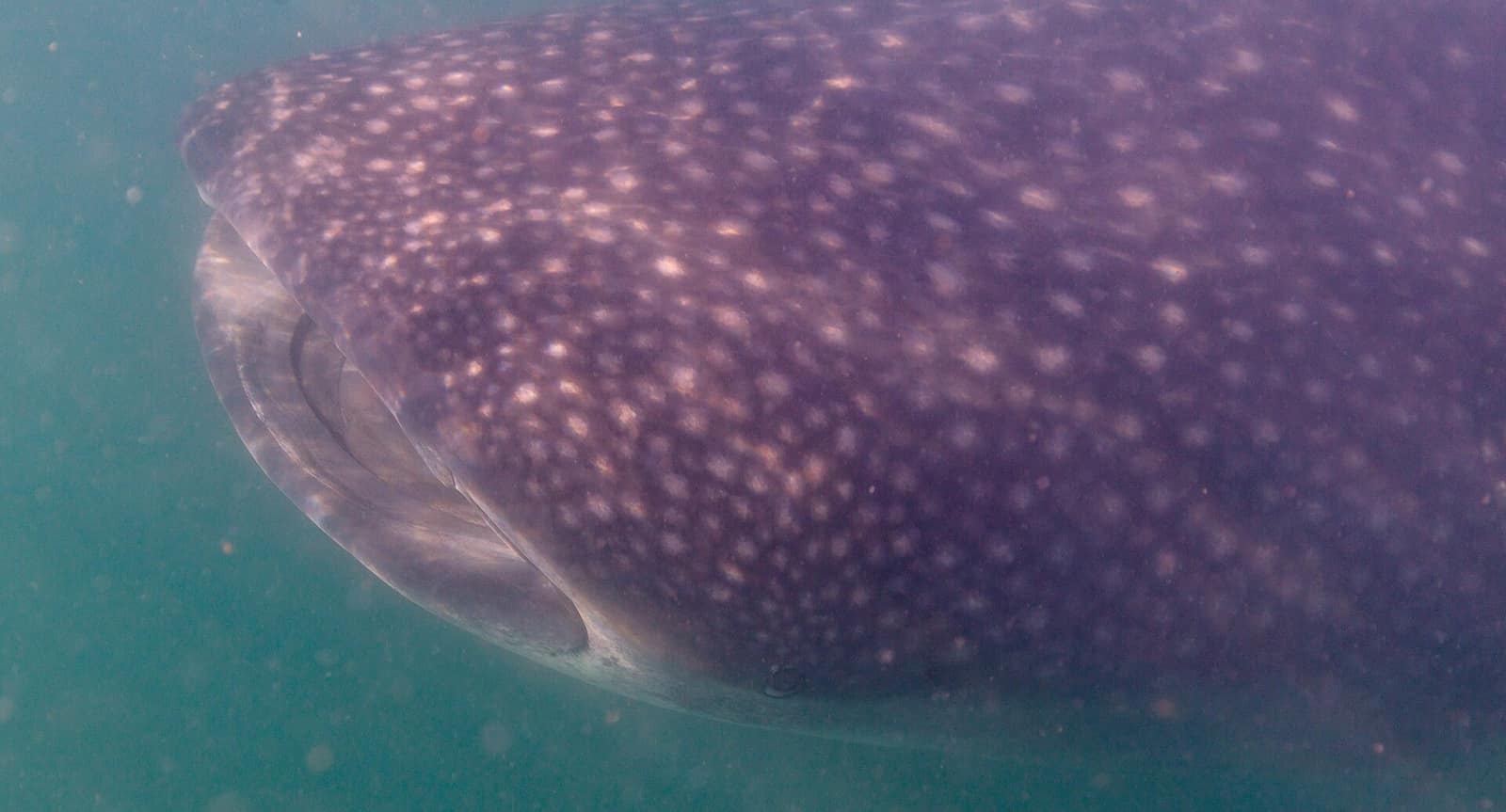
A typical whale shark encounter lasts 15 to 30 minutes before the boat regroups and locates a new animal or returns to the same one if it’s still feeding. Most tours include multiple encounters over the course of a two-to-three-hour water session. The quality of the experience varies by day: some days the sharks are moving fast and heading down, and encounters are brief; other days they’re slow-feeding in one area and you spend a long stretch beside the same animal.
Scuba diving with whale sharks is not permitted at La Paz. Tours are snorkel-only: mask, fins, snorkel, life vest. The rationale is partly conservation (bubbles disturb the sharks’ feeding behavior) and partly practical, since the sharks feed at or very near the surface where snorkelers can reach them without tanks.
Sea Lions at Los Islotes
Most whale shark tours out of La Paz include a stop at Los Islotes, a small rocky island about 45 minutes north of the city that is home to one of the largest California sea lion colonies on the Baja peninsula. The stop typically runs before or after the whale shark session, and the experience is completely different in character.
Sea lions at Los Islotes are accustomed to snorkelers. They approach on their own terms, darting around divers and snorkelers with no apparent concern about proximity. Young sea lions especially treat snorkelers as something to investigate: they’ll swim directly at your mask, pull off at the last moment, and circle back for another pass. It’s chaotic and close and genuinely engaging in a way that watching animals from a distance isn’t.
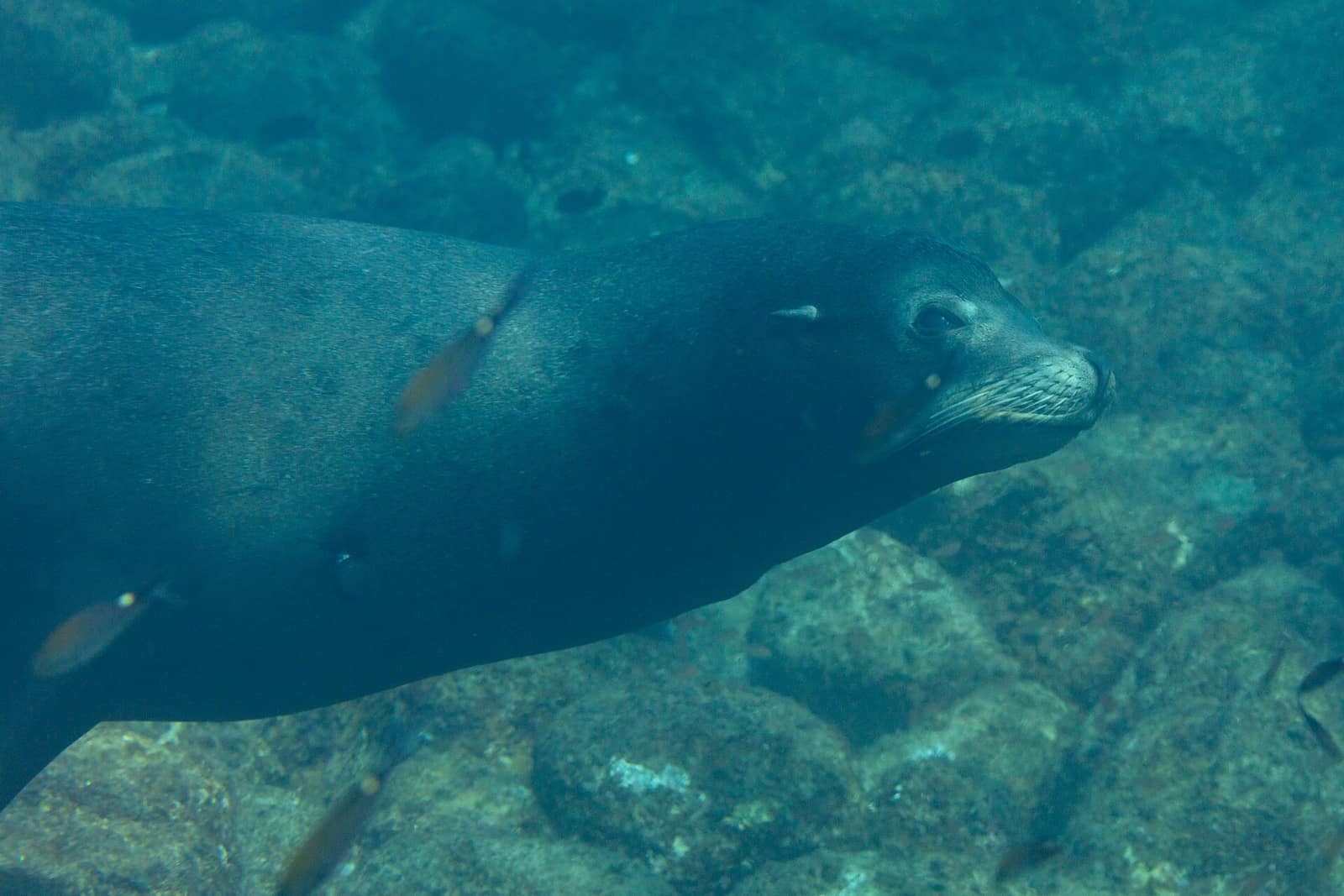
The sea lion stop runs 45 minutes to an hour. Water here is slightly cooler than in La Paz Bay itself. Bring a wetsuit top if you tend to get cold. The current can pick up depending on tide and wind, so stay close to the group and follow your guide’s positioning.
If the sea lion encounter interests you independently, the La Paz day trip page covers it alongside the other reasons to make the drive north, including Balandra Beach, which is one of the few completely sheltered swimming beaches in Baja.
Booking the Tour
Whale shark tours out of La Paz range from roughly $90 to $180 USD per person, depending on group size, what’s included (wetsuit, equipment, lunch), and the operator. These are estimate ranges; confirm current pricing directly when you book. The higher end of that range typically means smaller groups, a longer water time, and a more organized experience overall.
Most tour operators are based in La Paz and offer transportation from Cabo San Lucas as an add-on, usually at an additional $40 to $80 per person round-trip. If you’re coordinating a group of four or more, renting a car and driving yourself to La Paz is often cheaper than transportation add-ons, and it gives you the flexibility to stop for lunch in La Paz or at a beachside spot on the drive back.
Book ahead during peak season (November through February). Groups are capped in size, and quality operators fill their boats well in advance for weekends and Mexican holiday periods. The day trips activity page on this site includes additional context on logistics from Los Cabos.
A few things to look for when comparing operators:
- Group size: Smaller is better. Eight snorkelers per whale shark is about the maximum; six is more comfortable. Ask how many clients per guide before you book.
- Wetsuit availability: Essential October through March. Confirm the operator provides one in your size, or plan to rent in La Paz.
- SEMARNAT compliance: Reputable operators work within Mexico’s national park regulations, which set rules on approach distance, group size, and no-touch policies. If an operator is not mentioning these rules in their materials, that’s a flag.
- What’s included: Transfer, wetsuit, gear, lunch, park fees. Total cost matters more than the base price.
Getting There from Cabo
From Cabo San Lucas, take Federal Highway 1 north toward San José del Cabo, then continue through Miraflores and Santiago. The highway is two lanes through most of the route, well maintained, and scenic once you’re past the Corridor. Drive time is typically 2 to 2.5 hours, longer on holidays or if you stop in Los Barriles. Fuel up before leaving Cabo or in San José del Cabo; stations thin out after that.
La Paz itself is a larger city than most Cabo visitors expect, with 215,000 people, a proper malecón waterfront, and a number of good restaurants around the marina and centro. If you’re making a day of it, plan to arrive by 7:30 or 8 a.m. to be on the water at the best hour, then spend the early afternoon walking the malecón or having a late lunch before driving back. The full roundtrip with the tour runs about 10 to 12 hours from Cabo.
For a broader look at the La Paz day trip, including Balandra Beach and the malecón, the La Paz day trip from Cabo guide covers the full day in more detail.
What to Bring and What to Know Before You Go
Reef-safe mineral sunscreen is required, same as any marine park in Mexico. Chemical sunscreens are not permitted in the water. Bring yours from home or buy it in Cabo; availability in La Paz is fine, but it’s easier not to chase it down the morning of the trip.
On the boat:
- Reef-safe sunscreen (zinc or titanium dioxide only)
- A light rash guard or wetsuit top for sun and warmth
- Waterproof case or dry bag for your phone
- Motion sickness medication if you’re prone, taken an hour before boarding
- Snacks and water for the drive; the boat typically provides water and a snack
- Cash in pesos for lunch and any incidentals in La Paz
In the water:
- The tour provides mask, fins, and snorkel. Bring your own if you have a prescription mask or prefer your own gear.
- A 3mm wetsuit is standard and sufficient for most of the season. In January and February, some swimmers prefer a 5mm.
- Entry is from the side of the boat into calm water, typically not from a ladder. You should be comfortable treading water and swimming on the surface for extended periods.
Reasonable swimming ability is the main prerequisite. You don’t need scuba experience. Children as young as 8 or 10 can do this on most tours, though check the operator’s specific minimum age.
The best time to visit Los Cabos page breaks down the full seasonal picture across activities if you’re still deciding when to schedule your trip.
For many visitors, the whale shark day trip is the experience they talk about most after they get home. It’s a long day from Cabo, and it’s worth doing right.